
Read any AI research paper in about 10 minutes with Claude. This is the exact setup from my Reel: one Claude Project, three prompts, and a bonus prompt that turns a paper into code.
#1. Set up a Claude Project (2 minutes)
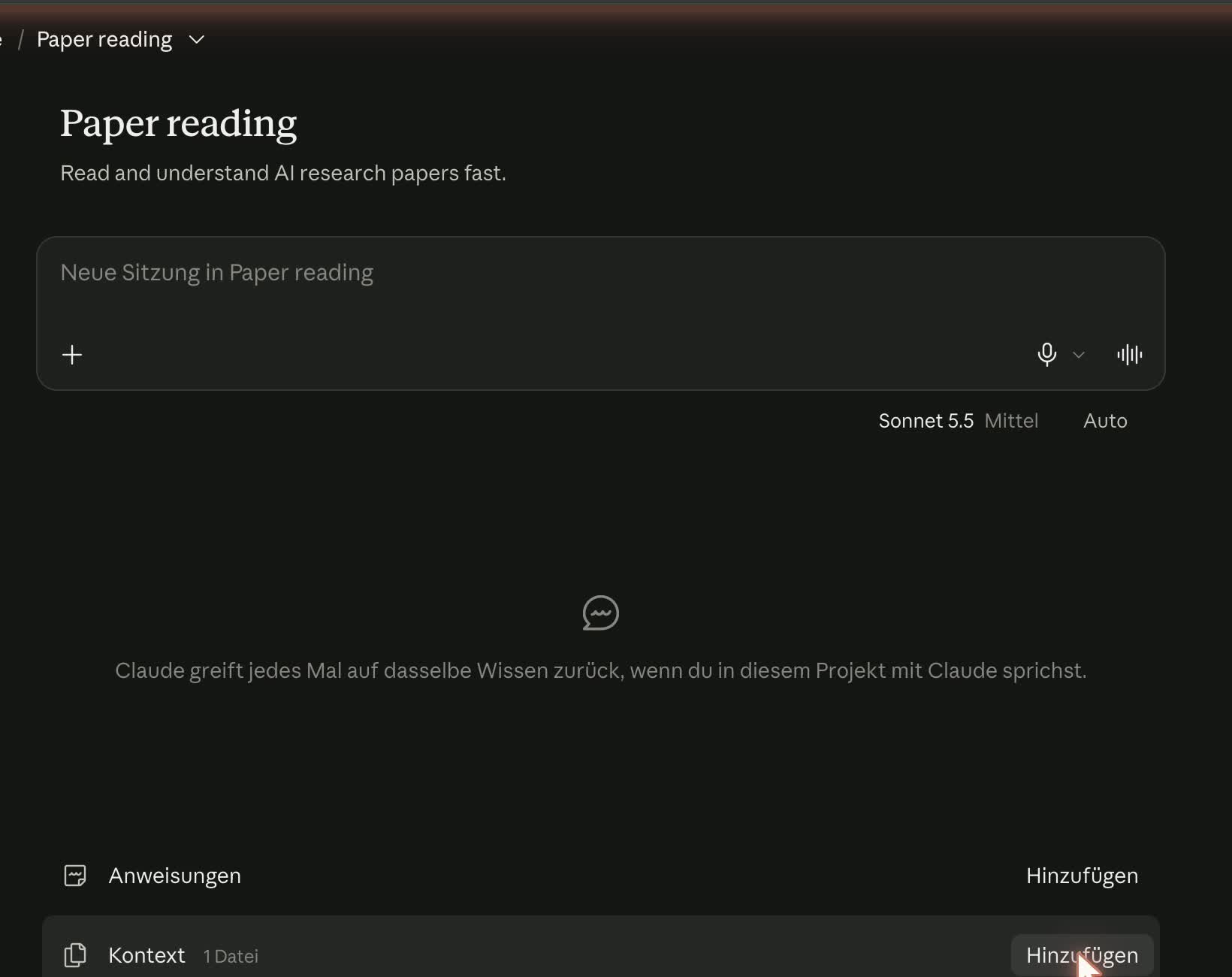
- Go to claude.ai, open Projects and click New project. Name it "Paper reading".
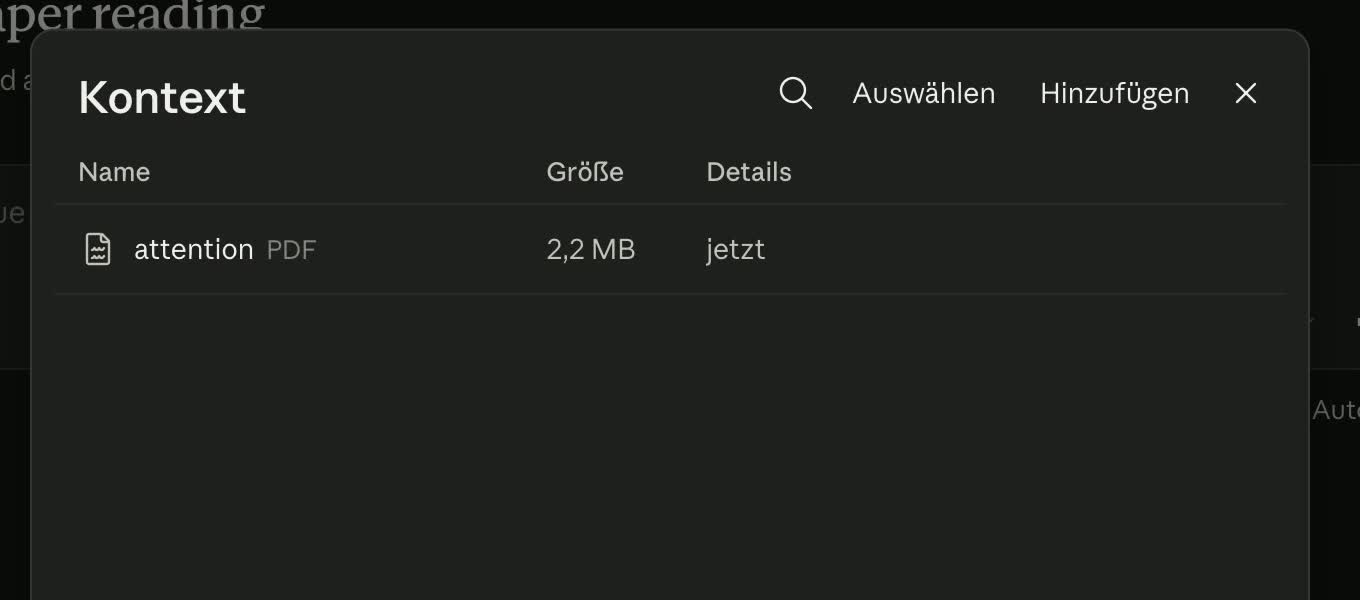
- Download the paper as a PDF (on arXiv: "View PDF") and add it to the project's Project knowledge (Context). Claude reads it once and every chat in the project can use it, so you don't re-upload it and you save usage.
- Add the project instructions below.
- Start a new chat inside the project for each question round.
#Project instructions (copy and paste)
Prompt
Always answer in English. I'm a [your role, e.g. AI engineer / doctor / student] reading research papers: be short, concrete and use simple words. When you quote a number, say which table or section it comes from. If the paper doesn't say something, tell me instead of guessing.#2. The 3 prompts (full versions)
In the Reel I show the short versions. These are the full ones I actually use.
#Prompt 1: Is this paper worth my time?
Prompt
Is this paper worth my time? In 5 bullet points: what question does it answer, what is new compared to earlier work, how strong is the evidence, who should read it, and your verdict (read fully, skim, or skip) for someone who works on [your topic]. Then list the 3 sections worth reading closely and the parts I can skip.#Prompt 2: What is the problem, the idea and the result?
Prompt
Explain this paper in three parts. Problem: why it matters, in 2 sentences. Idea: how it works, without jargon, with one concrete example. Result: the main numbers and what they mean in practice. End with the main trade-off and the one figure or table I should look at.#Prompt 3: Explain the hard parts to me
Prompt
List the 3 to 5 hardest parts of this paper (an equation, a method step or an experiment). Explain each one like I'm a smart engineer who is new to this subfield: first the intuition, then the details, then what would break without it. Quote the section you're explaining.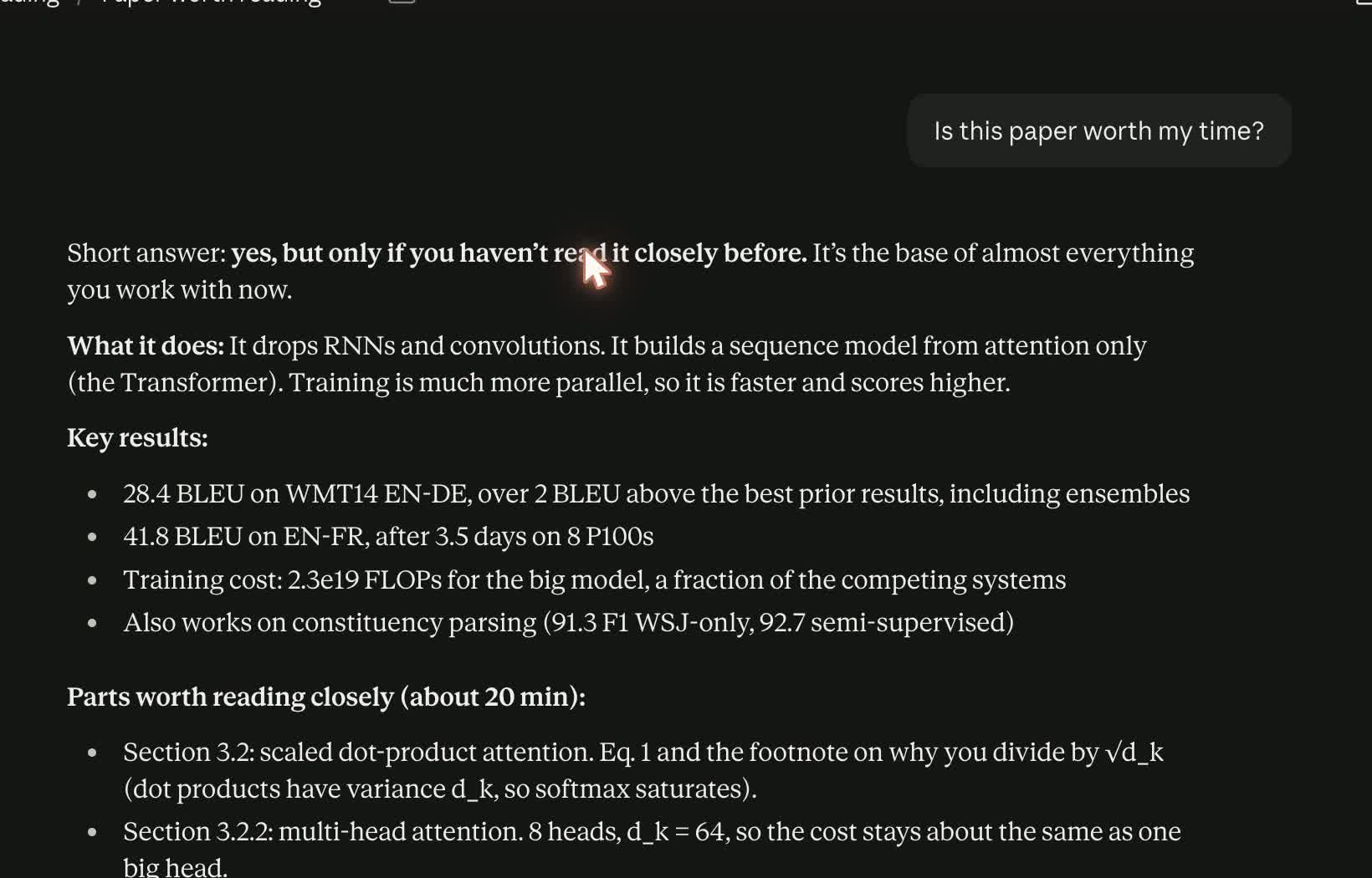
#3. Bonus prompt: turn the paper into code
The fastest way to really understand a paper is to build its core idea. Use this after the 3 prompts:
Prompt
Write a minimal, runnable PyTorch implementation of this paper's core idea in under 100 lines. Add comments that point to the section and equation each part comes from. Then give me one small experiment I can run in a few minutes to check that it works, and tell me what result to expect.#4. 10 AI papers every engineer should read
Run the 3 prompts on these in order. Each builds on the one before.
#5. Tips
- One project per topic, one chat per paper. Remove old PDFs when the project gets full.
- Ask for section numbers. It lets you jump straight to the right page and check Claude's answer.
- If an answer sounds too confident, ask "Where in the paper does it say that?"
Made by @sangeeths.ai: practical AI workflows from an AI engineer. Follow on Instagram for more. Share this kit: sangeeths.ai/paper · All free kits: sangeeths.ai